Licensed, Bonded & Insured San Diego County and Temecula Valley

Concrete Patios, Driveways & Masonry in San Diego

Good concrete work is mostly preparation: subgrade compaction, correct forms, the right mix for the application, and control joints where the slab wants to crack anyway.

We pour patios, driveways, walkways and stamped or colored finishes across San Diego, and handle block and masonry work alongside them.

Free in-home consultation · Same-day reply

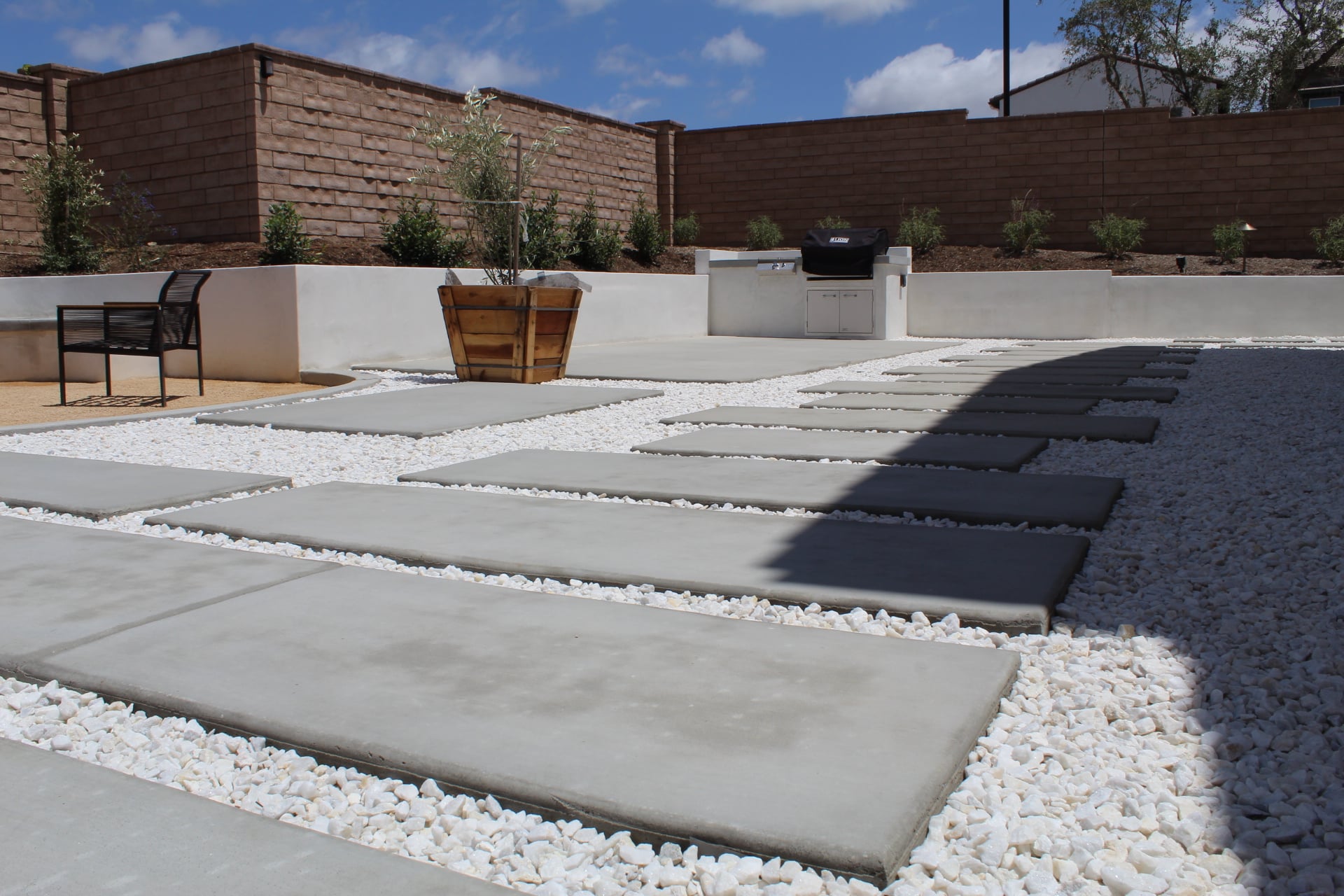
Poured concrete pads set in chip stone beside a seat wall and a built-in island
Licensed & Bonded Insured California contractor
30 Years Of founder’s trade experience
Up to 20-Year Craftsmanship warranty
4.9 · 160+ Reviews from local homeowners
Concrete & Masonry, end to end

What our concrete work includes

Forming & subgrade prep

Compacted subgrade and straight forms before any truck arrives.

Driveway & patio slabs

Application-matched mix design, thickness and reinforcement.

Stamped & colored finishes

Patterned and integral-color concrete that reads as custom, not gray slab.

Block & masonry

Garden walls, wall caps and masonry repairs done by the same crew.

Control joints & curing

Joints planned on layout lines and proper curing so surfaces last.

How it works

Four steps. One crew. Zero surprises.

  1. 01

    Walk the site

    We meet at your home, measure, talk budget and what you want out of the yard. The in-home consultation is free; your written quote follows in 2-3 days.

  2. 02

    Design & written quote

    You get a clear scope and a written quote: what we build, the materials, and the price. No surprises mid-build.

  3. 03

    Build

    Our own local crew does the work, from grading and hardscape to turf, walls and kitchens, with one point of contact throughout.

  4. 04

    Final walkthrough

    We walk the finished yard together and only call it done when you do.

Before you build

What to know about concrete patio and driveway finishes in San Diego

Finishes: what a concrete patio can actually look like

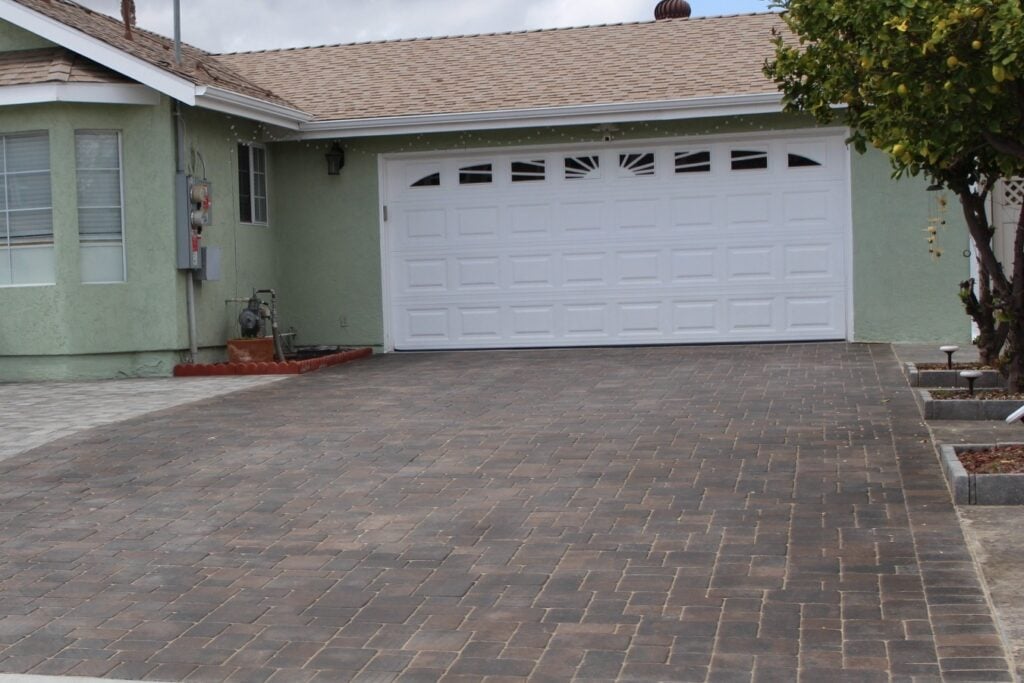
Plain gray concrete is one option among many, not the default you’re stuck with. A broom finish is the standard for slip resistance and shows up on driveways and patios alike. Exposed aggregate reveals the stone within the mix itself for texture and grip, a good fit for pool surrounds and sloped walkways. Stamped concrete presses a pattern, often stone or wood-plank, into the surface before it cures, giving a custom look for less than the equivalent material in real stone.

Color comes from two different processes worth understanding: integral color is mixed into the concrete itself and won’t wear off the surface, while acid stains and dyes are applied after the pour and sit closer to the top. Integral color holds up better under UV exposure over time; stains and dyes offer more variation and depth for the same slab. A trowel-smooth finish, meanwhile, suits covered patios where slip resistance matters less than a clean, refined surface underfoot.

Concrete slabs and foundations for structures and additions

Not all concrete is a patio or driveway. A concrete slab is the flat foundation under a shed, an outdoor kitchen, a patio cover’s footings or an equipment pad, and getting its thickness, reinforcement and subgrade right matters just as much as a decorative pour, since everything built on top depends on it. As a concrete slab contractor working across San Diego, we size and prep the slab for whatever it will actually carry, not a generic minimum.

A concrete foundation is a bigger step up: the structural base under an ADU, a room addition or a detached outdoor structure, engineered to the load above it and the soil beneath it. San Diego’s expansive clay and hillside lots often call for engineering and a soils consideration before a foundation goes in, which we coordinate as part of the project. Whether it is a simple slab or an engineered foundation, the same rule holds: the ground prep and reinforcement underneath decide how well it lasts.

What drives the cost of a concrete project

Size sets the baseline, and access changes it: a concrete truck or pump truck needs a clear path to the pour, and a backyard reachable only through a narrow side gate may require the concrete to be wheeled in by hand, which adds time. Demolition of an existing slab, patio or driveway adds cost separate from the new pour, and that cost depends on the old surface’s thickness and whether it’s reinforced.

Base depth and subgrade preparation matter more than most homeowners expect, since a slab poured over uncompacted soil will crack and settle regardless of the mix used. Material grade covers the mix strength and reinforcement, wire mesh or rebar, chosen for the application, and a driveway needs a higher grade than a patio. Slope factors in twice: once for drainage design, and again if the site itself needs grading before forms go in.

Concrete built for San Diego's ground and climate

San Diego County’s expansive clay and decomposed granite soils move with the seasons, and a slab poured without proper subgrade compaction will crack along those movements within a few years, not decades. Control joints don’t prevent that movement, they direct it: cut or formed on a planned grid, they give the concrete a place to crack that isn’t the middle of your patio. That’s engineering, not decoration, even though it ends up looking clean either way.

Coastal air adds its own slow damage: salt exposure accelerates corrosion on unprotected rebar, which is why cover depth and reinforcement choice matter more near the coast than inland. San Diego’s mild, mostly frost-free climate is kind to concrete compared to regions with hard freezes, but the marine layer and rapid afternoon heat still call for correct pour timing and curing so the surface doesn’t dry too fast or too slow. Structural slabs and masonry walls may also require permits depending on scope and jurisdiction.

Slab science: mistakes worth avoiding

The most common concrete failure isn’t the mix, it’s what’s underneath it: skipped subgrade compaction, missing or misplaced control joints, and a vapor barrier left out under a covered patio where moisture has nowhere to go. Reinforcement choice matters too. Wire mesh is standard for light-duty patios, while rebar is the right call for driveways and anything carrying vehicle weight, and using the lighter option under a heavier load is a mistake that shows up later as cracking.

Curing time is another place shortcuts show: concrete needs time to gain real strength before it takes vehicle weight, even though it looks and feels solid within a day or two. Ask any contractor what mix strength and thickness they’re specifying for your project and why, not just what it will look like. A straight answer on those specifics is a better indicator of quality than the finish sample they hand you.

Want a number before we talk? Book a free in-home consultation and get an exact written quote.

Book My Free Consultation
Homeowners on our work

What San Diego clients say

4.9 from 160+ client reviews

I had Sunny Builders re-build an existing wood and brick fence into a solid brick wall with stucco finish. I had them run an electrical line aline the wall for a future shed build. They were fast and got the project going right away. And now I have a great looking wall that makes my side and back yard look like a new house!

P Decker Google

We had a great experience with Sunny Builders. They just completed the first project for us, revamping our front yard. They were very efficient; just 2 days ago, our yard had was all weeds and dirt. We left the design to Sunny Builders and they made it look better than we imagined. They did the job quickly and at a very reasonable price with no surprise fees. I would definitely recommend them and we'll be using their services again.

Hans Baker Google

We recently had our side yard completely redone, and the experience with Sunny's Builders was incredible from start to finish. I was a bit nervous at first about hiring a company I found online, but I'm so glad I did. They exceeded every expectation! Our side yard looks incredible, and the entire process was smooth, professional, and stress-free. The team was professional, communicative, and truly cared about every detail. They transformed a space we had ignored for years into something beautiful and functional. We couldn't be happier with the results and highly recommend them to anyone looking for quality work and a stress-free process!

Lauren Benton Google

Read more reviews

Across the county

Where we build

From the coast to the foothills. Find your city on the plan, or in the list below.

Site-plan map of Sunny Builders’ service area: San Diego County and Temecula Valley The Pacific coastline runs down the left, a dashed line marks the service-area boundary, and featured cities are plotted as pins at their true locations. The pins are highlights, not limits: we build across all of San Diego County and Temecula Valley. The same cities are listed as links below the map. Pacific Ocean San Diego County Oceanside Carlsbad Encinitas La Jolla Solana Beach Del Mar Fallbrook Vista Point Loma Carmel Valley Bonsall Rancho Santa Fe Coronado San Marcos San Diego Temecula Rancho Penasquitos 4S Ranch Scripps Ranch National City Escondido Rancho Bernardo Chula Vista Bonita Poway La Mesa Santee El Cajon Lakeside Ramona Alpine Julian

We build across all of San Diego County and Temecula Valley.

Interactive map of featured cities Sunny Builders serves. Each pin links to that city’s page; the full list appears below. Service covers all of San Diego County and Temecula Valley, not only the pinned cities.
Good to know

Frequently asked questions

Stamped concrete or pavers, which should I pick?

Stamped concrete costs less and gives a continuous surface; pavers cost more and repair better. We will give you a straight comparison for your specific project at the consultation.

Will my new concrete crack?

All concrete moves. The craft is directing that movement into control joints and building a base that keeps it hairline instead of structural.

Can you match my existing concrete finish?

Usually close; exactly is honest talk, since sun and age change concrete color. Where a perfect match matters we discuss borders or full-panel replacement.

What is the difference between exposed aggregate and stamped concrete?

Exposed aggregate reveals the stone already inside the concrete mix by washing away the top layer of cement paste, giving a naturally textured, slip-resistant surface. Stamped concrete presses a pattern into the surface before it cures to mimic stone, brick or wood. Aggregate tends to read more natural and cost less in labor; stamped concrete offers more design variety and a more finished, decorative look.

How thick should a concrete driveway be?

Driveways need a thicker slab and stronger reinforcement than a patio because they carry concentrated vehicle load, not just foot traffic. The right thickness depends on your soil, the vehicles using it and local code minimums. We specify it based on your site rather than a generic number, and it appears in your written quote.

Does concrete need to be sealed?

Sealing isn't strictly required for the slab to function, but it helps protect against staining, efflorescence and UV fading, especially on stamped or colored concrete. Unsealed concrete will still perform structurally, it just weathers and stains more visibly over time. We can walk you through sealing options and how often resealing is typically needed for your finish.

Can you build a concrete patio around an existing structure like a pool or fireplace?

Yes, tying new concrete into existing structures is common work, and it requires careful attention to expansion joints where the new slab meets anything rigid, so the two surfaces can move independently without cracking each other. We assess the existing structure's condition and grade on-site before finalizing the plan.

Do you pour concrete slabs for sheds, outdoor kitchens and patios?

Yes. A concrete slab is the flat base under a shed, an outdoor kitchen, a spa or a patio cover, and we prep and pour it as its own scope or as part of a larger project. The key is matching the slab thickness, reinforcement and subgrade prep to what will sit on it, since a slab under a heavy outdoor kitchen or spa needs more than one under a light garden shed. We specify it for your actual use, not a one-size number.

Can you pour a concrete foundation for an ADU or room addition?

Yes, foundation work is part of what we do, and it is structural, engineered concrete rather than a simple flatwork pour. A foundation under an ADU, addition or detached structure is designed for the load above it and the soil conditions on your lot, which in much of San Diego means accounting for expansive clay or a sloped site. That engineering and any required soils work is coordinated as part of the project before the pour.

What warranty covers this work?

Warranty length follows the material we install: concrete 10-Year. That is our workmanship warranty on the installation, written into your contract, and we walk through exactly what it covers on your project at the in-home consultation.

Before you commit

Guides for your project

Often built together

Related services

Free in-home consultation

Tell us about your project

Send the form and we’ll call you back to book your free in-home consultation. Or skip the form entirely:

(858) 888-1725

Takes about 30 seconds. No spam, ever.

Your free in-home consultation usually takes 30–60 minutes. Your written quote follows within 2–3 days.

4.9 on Google · 160+ reviews

Licensed, Bonded & Insured · CSLB #1098213 · BBB A+ Rated

By submitting, you agree we may call, text, or email you about your project. Opt out anytime. Privacy policy