
Ask three neighbors what their backyard remodel cost and you will get three different answers that do not seem to describe the same kind of project. That is not because contractors are cagey about numbers. It is because a backyard remodel is not one price, it is five or six separate decisions stacked on top of each other, and each one moves the total independently.
This is not a pricing page. It will not give you a number, because any number without seeing your yard would be a guess dressed up as an answer. What it will give you is the actual levers that move a backyard remodel‘s cost up or down, in plain language, so you walk into a consultation asking the right questions instead of just hoping the quote feels fair.
The Five Levers That Actually Move the Number
Square footage sets the baseline, and it scales close to a straight line: more yard means more base material, more turf, more planting and more labor across every trade involved. Grading is the lever most homeowners never think about until they hear it named. A flat yard with easy machine access builds efficiently, while a sloped lot needs retaining walls, terracing or serious regrading before a single paver goes down, and none of that work is visible in the finished photos.
Access is the quiet cost multiplier. A backyard reachable by wheelbarrow or small equipment through a wide side gate builds faster than the same yard behind a narrow locked gate that forces crews to hand carry every bag of base material and every paver. Steep driveways, tight side yards and a total lack of staging space all slow a project down before anyone touches soil, and that time shows up in the labor line whether the yard is large or small.
The Levers You Control: Trade Count and Material Grade
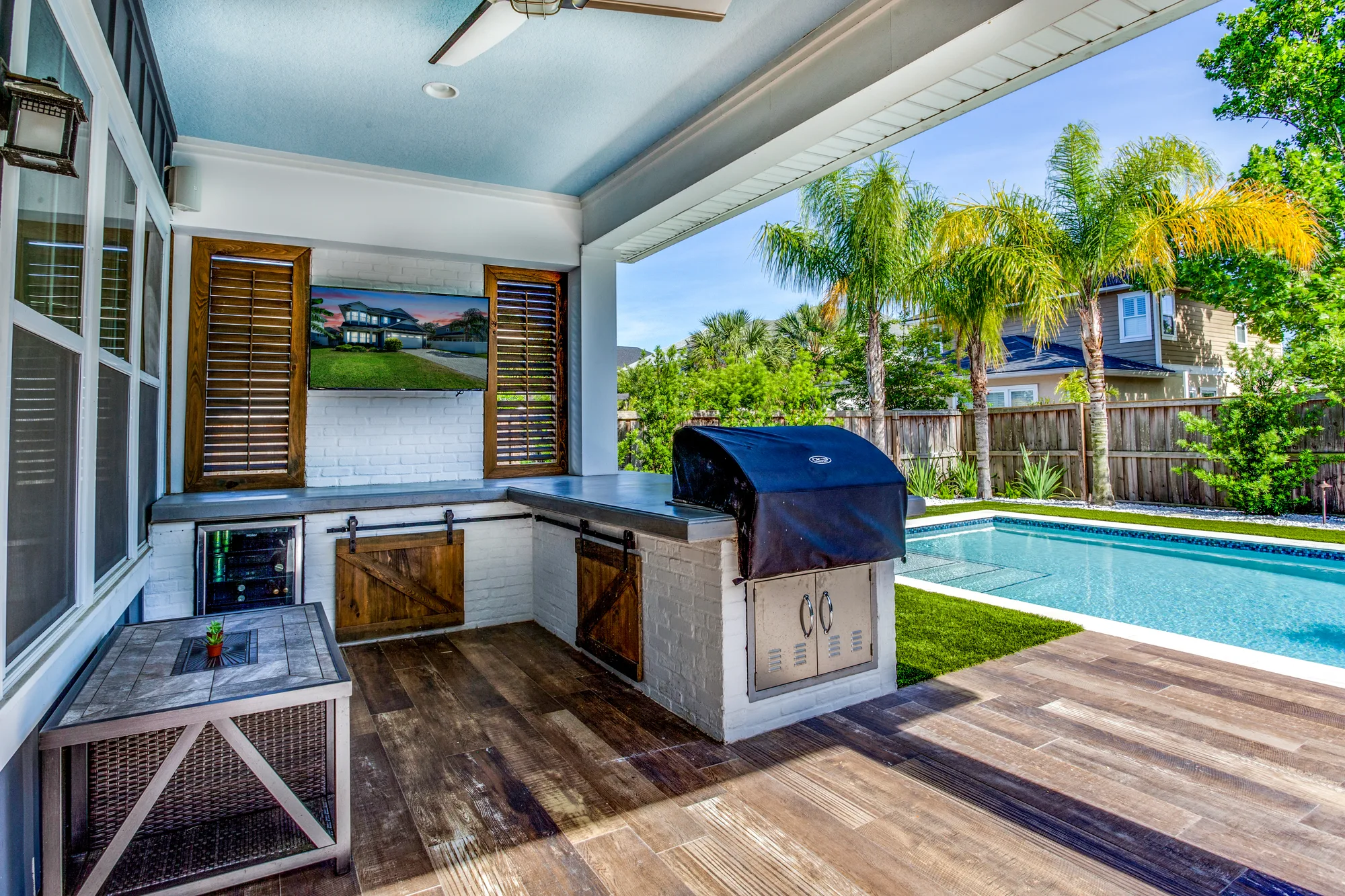
Trade count is where scope decisions turn into cost decisions. A patio and turf project touches two or three specialties at most. A full remodel with an outdoor kitchen, fire feature, lighting and a retaining wall coordinates hardscape, electrical, gas and masonry on one site, and every trade added means more scheduling and more places for a delay in one to ripple into the next. That is not a reason to scale back your vision, it is a reason to see the full scope in one written quote before work starts.
Material grade is the lever you feel the most and control the most directly. Standard concrete pavers, mid range turf and a simple built in fire pit sit at one end. Large format porcelain, natural stone, a full masonry fireplace and premium turf blends sit at the other, often on the exact same footprint. Neither choice is wrong. What matters is choosing deliberately, line by line, instead of letting a showroom sample decide it for you before you have seen the whole yard priced out.
Where Backyard Budgets Quietly Leak
The biggest leak is not a material upgrade, it is sequence. Buying furniture, a grill island or a fire table before drainage and grading are settled is how homeowners end up paying twice, once to build around a feature that was never coordinated with the base plan, and again to fix a low spot that was there from day one. Get the ground right first. Everything placed on top of it should be the last decision, not the first.
Change orders are the second leak, and they almost always trace back to a decision made trade by trade instead of as one yard. A paver pattern chosen before the turf line is finalized, an electrical run added after the hardscape is already poured, a retaining wall built without the drainage plan behind it. Each fix in isolation looks small. Stacked across a project, they are usually where a tight number stops looking tight.
Where to Save and Where to Never Skimp
Some corners cost you nothing to cut. Turf blend, paver pattern complexity, and how elaborate the lighting plan is are all places where a simpler choice still looks intentional and performs the same for years. These are style decisions more than performance decisions, and scaling them back to fit a budget rarely shows up five years later.
Base preparation, drainage and structural retaining walls are the opposite. These are the parts nobody photographs and everybody eventually notices, because a shortcut underground surfaces as a cracked paver, a soggy corner of lawn or a wall that leans within a few seasons. If a quote saves money by trimming excavation depth or compaction, that is the one place the saving is not worth taking.
Phasing Your Remodel Without Losing the Plan
Not every yard has to happen at once, and phasing is often the smarter move rather than the compromise it sounds like. Get grading, drainage and hardscape right in phase one, since every later feature builds on top of that foundation. Add the outdoor kitchen, fire feature or pergola in a second phase once budget allows, on infrastructure that was already planned to carry it.
The trick to phasing well is designing the whole yard up front even if you build it in stages, so utility runs, grading and access points do not have to be redone later. If you are still in the planning stage and want a rough sense of scale before a full design conversation, our free cost calculators put a starting price on the pieces most yards are built around, like a paver patio or a retaining wall. They are a starting point, not a substitute for measuring your actual site.
Every yard prices differently, and the only way to get a real number is to have us walk yours. Schedule a free in-home consultation and we will give you a written, itemized quote, so you know exactly what you are paying for before anything is built.