
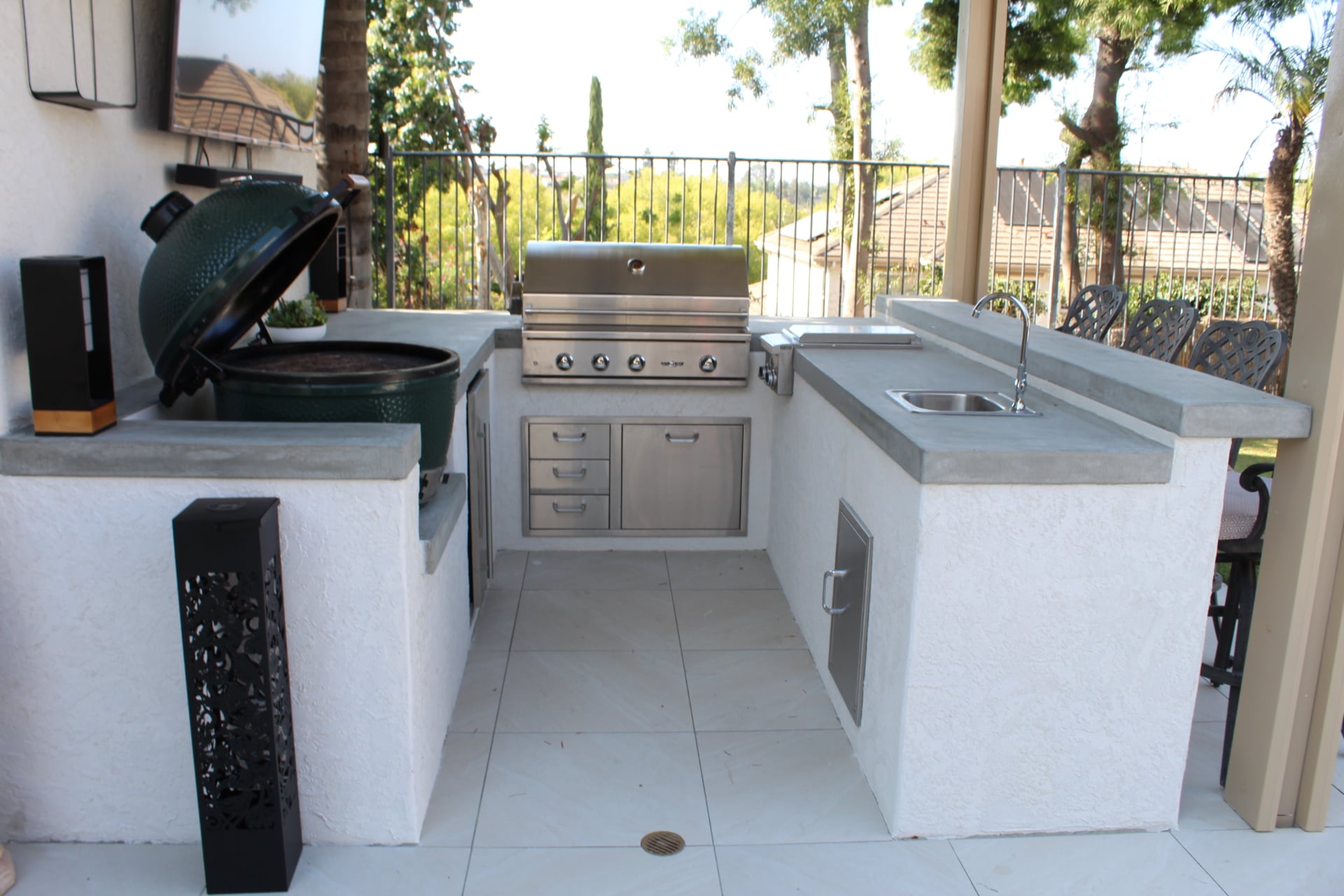
An outdoor kitchen is one of the few backyard features people research for months before they call anyone. It is a real investment, it is permanent once it is built, and unlike a patio or a lawn, it only earns its place if you actually use it. So the honest question is not whether outdoor kitchens are nice to have. They are. The question is whether one is worth it in your yard, with your habits, at the scope you are currently picturing.
This is not a pitch. It walks through the case San Diego weather genuinely makes for cooking outside, the difference between a full built-in and a simple grill island, the utility work almost nobody budgets for, the materials that survive our coastal air and inland heat, and the homeowners who end up wishing they had put the money somewhere else. Read it as a decision aid rather than a sales page, because the wrong version of this project is an expensive thing to leave sitting unused.
The San Diego Climate Argument, Assessed Honestly
Year-round use is the entire case for an outdoor kitchen here, and it is a strong one. In most of the country a built-in cooking area is a summer amenity that sits under a cover for half the year, which makes the math hard to justify. San Diego does not have that problem. Mild winters, dry evenings and long stretches of usable weather mean a well-placed outdoor kitchen is available most weekends of the year, and availability is what turns a feature into a habit instead of an occasion.
The honest caveat is that the climate makes it possible, not automatic. Coastal yards deal with a morning and evening marine layer that can leave an uncovered counter damp and cool at exactly the hours you want to be out there. Inland valleys run hot enough in late afternoon that a west-facing cook station is miserable right at dinner time. Shade, a wind-sheltered position and some overhead cover are what convert good weather into actual use, and they belong in the plan from the start rather than bolted on later.
It is also worth naming what the climate argument is not. It is not a resale argument. Buyers do notice a well-built outdoor kitchen, but leaning on future resale to justify the spend tends to push people toward a bigger build than they need, finished in whatever happens to be fashionable this year. The reliable justification is use. If the weather means you will cook and eat outside most weeks of the year, the value is real and you feel it immediately. If it will not change how you live, no amount of good weather fixes that.
A Full Built-In or a Simple Grill Island: Who Each Suits
A grill island is the smaller version, and it solves the most common complaint about cooking outside, which is having nowhere to put anything down. It is usually a masonry or steel-framed counter with a built-in grill, some storage below, and enough landing space on both sides to work without juggling plates. It often needs one utility connection rather than several, and it can sit on an existing patio when the slab is up to it. For a household that grills a couple of times a week and eats at a table nearby, that is frequently the whole answer.
A full built-in is a different category. Sink, refrigeration, side burner, bar seating, sometimes a pizza oven, usually a cover overhead. It stops being a grill with counters and becomes an outdoor room, which is exactly why a full built-in outdoor kitchen runs meaningfully more than a grill island. The cost is not the extra length of countertop. It is the trades. Plumbing, electrical, gas and masonry all have to show up and coordinate on one site, and anything with a roof over it brings structural work along too.
Which one suits you comes down to how you already entertain. If you host often and the recurring pattern is one person stranded at the indoor sink while everyone else is out back, the built-in is solving a genuine problem, because the sink and the refrigerator are what keep the cook in the conversation. If your gatherings are smaller and the grill is the only piece you would truly use, the island version delivers most of the benefit without the trades, and it leaves budget for seating, shade and lighting, which is usually what decides whether a yard gets used at all.
The Utility Runs Nobody Budgets For
Three utilities drive most of the real cost, and none of them appear in the finished photos. Gas has to come from the meter in a line sized for the burner load you are adding, which is not always the same line that would feed a fire pit. Electrical means a dedicated circuit with outdoor-rated, ground-fault-protected outlets for refrigeration, lighting and anything that plugs in. Water means a supply line and, more importantly, a drain, because a sink has to empty somewhere legal rather than into the planting bed behind the counter.
Distance from the house is the multiplier on all three. Every foot between the connection point and the kitchen is trench, and trench is labor plus the cost of putting back whatever was sitting on top of it. Running gas and a circuit across open dirt before anything is built is straightforward work. Running the same lines under a finished paver patio, a driveway or a mature planting bed means cutting, restoring and matching, and that is where a quote grows for reasons that have nothing to do with the kitchen itself.
Gas and electrical work of this kind generally pulls a permit and gets inspected, which is a good thing rather than an obstacle, though it is a scheduling reality worth knowing before you plan a party around the finish date. Ask anyone you talk to how they intend to route each utility, what has to be opened up to get there, and who is pulling the permit. A quote that never mentions trenching is a quote that has not thought about it yet, and that thinking has to happen eventually.
Materials That Survive Coastal Air and Inland Heat
San Diego is really two material environments, and the same build ages differently in each. Within reach of the ocean, salt air is the deciding factor. It finds cheap stainless first, and it shows up as rust bleeding from hinges, screws, drawer slides and the seams of a grill hood long before the countertop shows any age at all. Near the coast, marine-grade stainless for appliances and access doors, with hardware chosen for corrosion resistance rather than price, is the difference between a kitchen that still looks right in several seasons and one that does not.
Inland, heat and sun are the stress instead. Dark countertops soak up afternoon sun and become uncomfortable to touch, sealers on porous stone break down faster under constant UV, and composite faces fade unevenly. Lighter tops, porcelain or well-sealed concrete, and real shade overhead all hold up better. Shade is doing double duty here, because it protects the materials and it is also the thing that makes the space usable during the exact hours you would want to be cooking in it.
Underneath the finish, the structure matters more than the surface. A cook island should be built on masonry block or steel framing with cement board, never wood framing hidden behind a nice face, because wood plus heat plus moisture is a slow failure you will not notice until something sags or smells. Ask what the box is made of, not only what is on top of it. The countertop is the decision homeowners agonize over, and it is rarely the part that fails first.
Who Ends Up Regretting an Outdoor Kitchen
The clearest pattern is homeowners who do not already cook outside. An outdoor kitchen amplifies an existing habit, it does not create one. If the grill currently comes out a handful of times a year, a larger and more permanent version of the same thing will come out a handful of times a year, just with better counters around it. The people who are glad they built one are almost always the ones who were already cooking outside constantly and were tired of working off a wobbly cart and a folding table.
The second pattern is layout. A kitchen placed far from the indoor kitchen and the door connecting them gets used less, no matter how good it looks in photos. If you still have to carry every plate, drink and utensil across the yard, you have built an expensive grill surround rather than a kitchen. The same applies to a cook station that faces away from where everyone sits. Cooking alone with your back to the party is not what anybody pictured when they started planning this project.
The third is specifying for an imagined life instead of the real one. Pizza ovens, kegerators, warming drawers and second grills all sound excellent in a design meeting, and several of them tend to go untouched. Be honest about which appliances match how you genuinely eat, then move the savings into shade, seating and lighting. Those three decide whether people linger outside after dark, and lingering is the entire point of building the thing.
Build It Now, or Rough In the Utilities for Later
If the budget does not stretch to the kitchen you want but other work is happening in the yard anyway, roughing in is the smartest decision on the table. While the ground is open, run the gas stub, a conduit for power, and a water supply and drain to the spot you have chosen, cap them, and photograph the layout before anything covers it. It is a small line item during construction, and it protects you from the expensive version later, which is cutting into a finished surface to reach a connection point.
That approach pairs naturally with phasing the yard rather than shrinking it. Get grading, drainage and the patio right in the first phase, since the kitchen sits on top of all three, then build the cooking area later on infrastructure that was planned to carry it. If you are still sizing up the whole project, our paver patio cost calculator puts a starting price on that first-phase patio, and our breakdown of what drives backyard remodel cost helps you frame the budget for the yard as a whole, which is the number that actually matters when you are deciding what to build first.
The option that costs the most over time is building a patio now with no idea where a kitchen might eventually go. That is how homeowners end up with a beautiful surface, an obvious spot for a cook island, and a gas meter on the wrong side of the house. Deciding the location costs nothing even when building it does, so settle that question on paper now and you keep every option open for whenever the budget catches up.
Still deciding whether an outdoor kitchen is worth it in your yard? Book a free in-home consultation and we will look at your real layout, how far the utilities have to travel and how you actually use the space, then back it with a written, itemized quote for the version that fits, whether that is a full built-in or a simple grill island.