
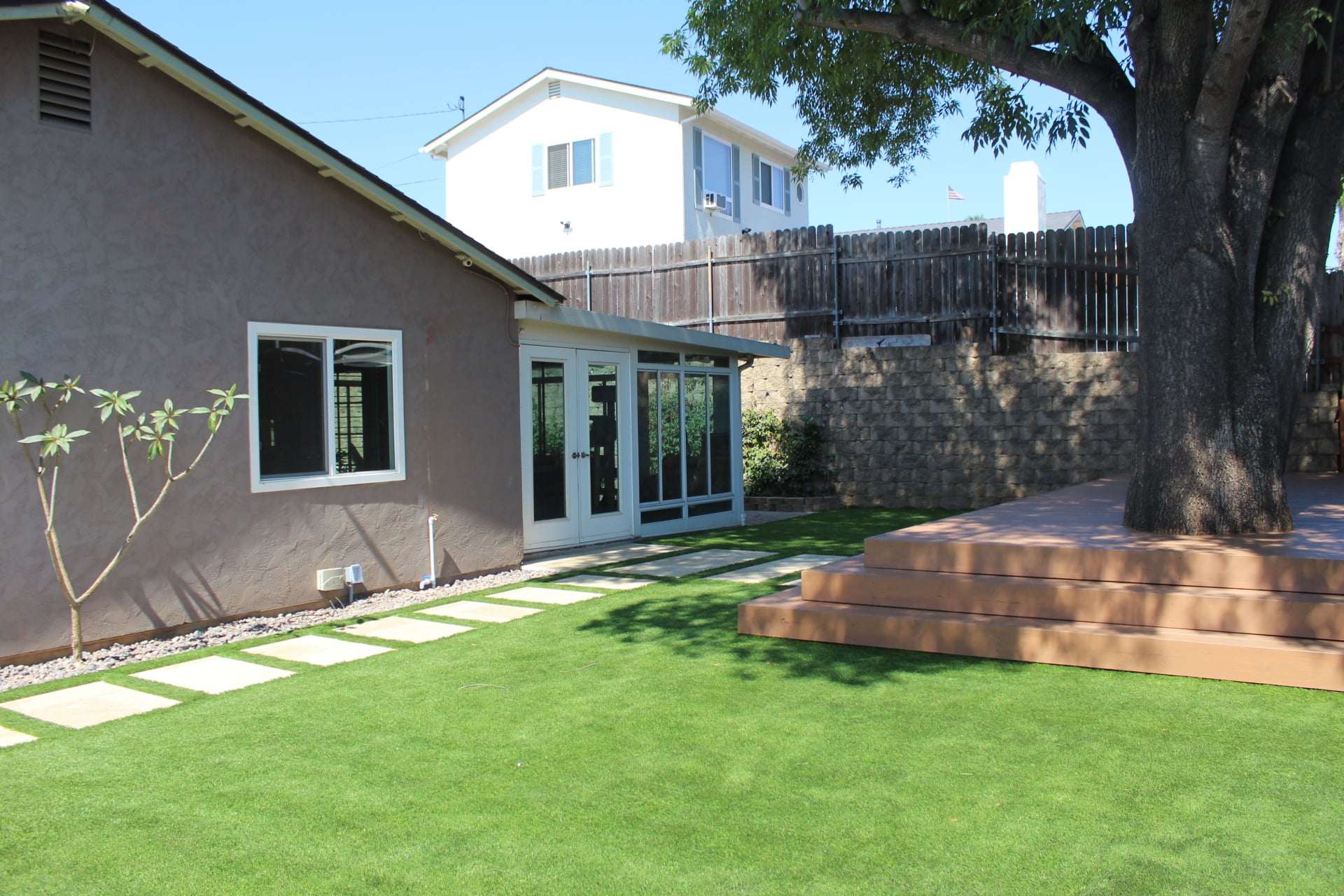
A lawn that only has to look good for photos is a different project than a lawn that has to survive a Labrador and two kids who use it every single day. If you are researching artificial turf because your real grass cannot keep up with the dogs, or because you want a yard the kids can run on barefoot without you worrying about it, the questions that matter are not the ones most turf ads answer. Drainage, odor, infill and heat are where a pet-and-kid lawn either holds up or turns into a daily annoyance.
This guide walks through what actually changes when a turf system has to serve dogs and children, not a showroom photo. It does not cover whether turf beats real grass in general, that comparison lives in a separate guide, and it does not make the case for hiring anyone in particular. It is here to help you understand what to ask for, what a fair bid should include, and what to realistically expect once the lawn is in daily use by your family and your pets.
How Pet Turf Actually Differs From Standard Turf
Standard turf and pet turf can look nearly identical sitting in a showroom, but the difference is almost entirely underneath the surface. A system built for dogs uses a more open-weave backing that lets liquid pass through quickly instead of pooling on top of a solid membrane, paired with a base built to drain rather than just support foot traffic. Skip that step and the turf itself may be fine while the ground underneath slowly turns into the actual problem.
Pile height and density matter too, but not in the direction most people assume. A shorter, denser blade sheds debris and dries faster than a tall, thick blade that looks lush in a sample swatch but holds moisture and fur against the backing. None of this shows up when you are comparing swatches by hand. It shows up six months in, which is exactly why the base and backing deserve more attention than the blade color.
Drainage and Odor Control, Explained Honestly
No artificial turf system eliminates odor on its own. What a well-built system does is give urine and waste a fast path down through the turf, through the infill, through a permeable base, and away from the surface instead of sitting on top of it. A base built with proper depth and the right aggregate drains meaningfully faster than a shallow, undersized one, and that speed is most of what keeps a yard from smelling on a warm afternoon.
The honest caveat is that a dog that reliably uses one corner of the yard will need a bit more rinsing in that spot no matter how good the system is underneath. That is normal and manageable with an occasional hose-down, not a sign the turf was installed wrong. What is not normal is standing water or a persistent smell across the whole lawn, and that almost always traces back to a base that was not built with drainage as the priority from day one.
Infill Choices When Pets Are Part of the Picture
Infill is the layer of material worked down between the blades that holds them upright and adds weight to the system, and it is one of the biggest variables in how a pet lawn performs over time. Standard silica sand infill is common and inexpensive, but it does not do anything to manage odor on its own. Antimicrobial and zeolite-based infills are built specifically to neutralize urine odor at the source rather than just letting it pass through, and they are worth the upgrade in most households with dogs.
There is no infill that makes odor control permanent and maintenance-free, and any pitch that promises otherwise is overselling the product. What changes with a better infill is how much rinsing and how frequent a refresh a system needs to keep smelling clean over the years, and a pet-rated infill genuinely stretches that interval out compared with plain sand. If a bid does not specify which infill is going into a yard with dogs, that is a fair, direct question to ask before signing anything.
Managing Heat on Sunny Afternoons
Turf gets warmer than real grass in direct sun, and there is no product or infill that fully erases that fact on a hot San Diego afternoon. A lighter-colored blade reflects more heat than a dark one, and a yard with some afternoon shade from a tree, patio cover or fence line will run noticeably cooler than one in full, unbroken sun all day. Orientation and existing shade on the property are worth discussing before you pick a color or a system.
For dogs and bare kids’ feet, a quick rinse with a hose before outdoor time on a hot day brings the surface temperature down fast and is the simplest tool available. Scheduling yard time for morning or early evening on the hottest days works the same way real grass owners already plan around summer heat. None of this is a defect specific to turf, it is a property of any synthetic surface in direct sun, and planning around it is straightforward once you know to expect it.
Building a Kids' Play Area That Holds Up
A section of yard that gets steady foot traffic from running, a trampoline or a swing set puts different demands on turf than a decorative front lawn does. Higher-traffic zones benefit from a denser pile and a firmer, well-compacted base so the blades keep springing back upright instead of matting down in the paths kids actually use every day. That is a conversation worth having up front, not after the lawn already shows wear patterns.
Turf also removes some of the everyday hazards a real lawn develops under heavy use, like bare dirt patches, uneven divots or exposed sprinkler heads, and it stays consistently soft underfoot for falls during play. It is not a cushioned safety surface built to a playground standard, so a swing set or trampoline still benefits from proper fall-zone padding underneath, the same way it would on any yard surface. Turf is a strong everyday play surface, not a substitute for that equipment’s own safety spec.
What Cleaning and Upkeep Actually Look Like
A pet-and-kid lawn is genuinely lower maintenance than real grass, but it is not zero maintenance, and it helps to know what the routine actually is before you commit to a budget. Solid waste needs to be picked up the same as it would on real grass, ideally the same day. A regular rinse-down, more often in the spot a dog favors, keeps odor from building, and an occasional brushing against the grain keeps the blades standing upright instead of flattening under repeated traffic.
Beyond that, an occasional deeper clean or infill top-up over the years keeps an older lawn performing the way it did when it was new. None of this is a large time commitment once it is part of a routine, but it is a real one, and any contractor who tells you a pet turf lawn needs literally nothing after installation is not giving you the full picture. If you want to see how the base, infill and traffic level you are planning for translate into a realistic budget, our free artificial turf cost calculator is a faster starting point than guessing from an average online.
If you are weighing turf for a yard that dogs and kids actually use every day, we offer a free in-home consultation where we look at your drainage, sun exposure and traffic patterns and recommend a base, backing and infill built for how your family uses the yard, not a showroom sample. For the broader turf-versus-grass question, see our honest comparison.