
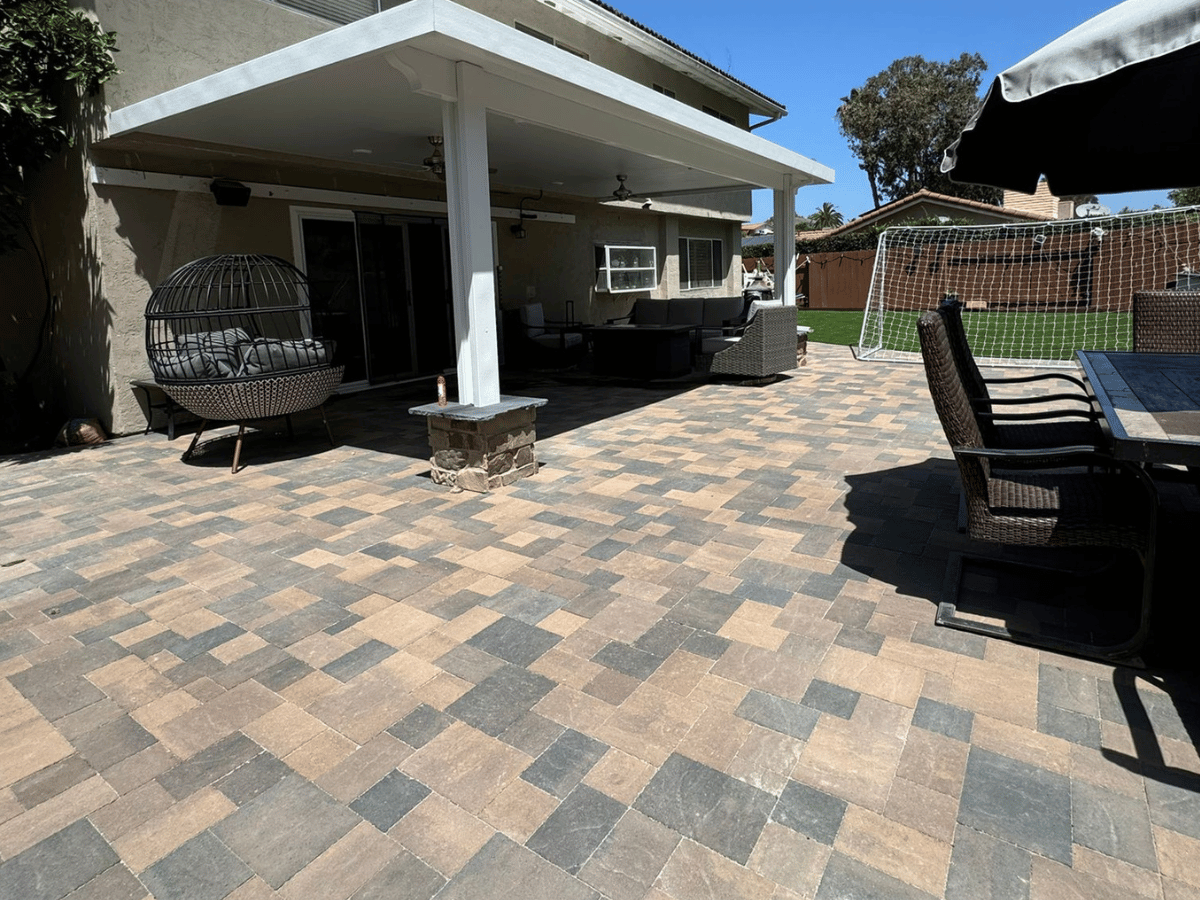
You searched for the paver patio cost in San Diego hoping to land on a real number, and instead found five different websites quoting five different ranges that all seem to contradict each other. That is not because contractors are hiding something from you or trying to confuse the process. It is because a paver patio genuinely cannot be priced accurately without someone seeing the yard it is going into first.
This guide skips the vague reassurance and explains exactly why the number moves so much from yard to yard, what genuinely changes the price, and how a simple patio compares to a complicated one in real terms. By the end you will know what questions to ask and how to get a planning range built around your actual property instead of a stranger’s average.
Why No One Can Give You an Honest Number Over the Phone
Ask five paver companies for a price without letting anyone walk the yard, and you will get five guesses dressed up as quotes. A patio’s price depends on what is under the surface and around it: soil type, existing grade, how a crew and materials will actually reach the work area. None of that is visible from a phone call or a photo, no matter how detailed the description.
A number given before anyone sees your yard is either a rough average that will move once the crew arrives, or a low figure meant to win the job with the real cost arriving later as change orders. Neither serves you. A contractor who insists on an on-site visit before naming a figure is not stalling, they are trying to give you something you can actually plan around.
What Actually Moves the Price, Yard to Yard
Size sets the starting point, but it rarely explains the gap between two quotes for similarly sized spaces. Access does more work than most homeowners expect: a patio a machine can reach costs meaningfully less to build than the same patio behind a narrow side gate, where base material and pavers have to be carried in by hand, load by load.
Demolition is the next hidden factor. Removing an old concrete slab or a tired lawn takes real time and disposal effort before the new patio can even begin, and that step is priced separately from the paving itself. Base depth and material grade move together too: a patio needs less compacted base than a driveway, and premium porcelain or natural stone will always ask for more than standard concrete pavers.
Slope adds a cost most online calculators never see: a yard that pitches toward the house needs regrading before a single paver goes down, and that earthwork is its own line item. Pattern complexity is the smallest factor of the group. A simple running bond lays faster than an interlocking herringbone, but the difference is measured in labor hours, not a different category of project.
A Simple Patio Versus a More Involved One
Picture the easiest version of a paver patio job: a flat, open backyard reachable by wheelbarrow or small machine, starting from bare dirt or gravel with nothing to remove, using standard concrete pavers in a straightforward running bond pattern. That combination of factors, easy access, no demolition, standard material, simple layout, adds up to the most economical version of this project by a wide margin.
Now picture the opposite: a sloped lot that needs regrading before any base goes in, access only through a locked side gate that forces every load to be hand-carried, an old concrete slab to demolish first, and a homeowner who wants large-format porcelain in a herringbone pattern with a contrasting border. Every one of those choices is reasonable on its own, but stacked together they add up to meaningfully more than the simple version, and a fair contractor lays out which ones are driving it.
How to Budget Smartly Before You Call Anyone
Start by deciding what actually matters to you: is it the size of the patio, or the material sitting on top of it? Most homeowners can flex on one but not both, and knowing which one you would trade first makes every conversation with a contractor faster and more useful, because you can react to real options instead of getting talked into upgrades you never asked for.
Insist on quotes that walk your actual yard rather than a number quoted over the phone, and ask for the number broken into line items: demolition, base, material, edge restraint, joint sand. That breakdown is what lets you compare two contractors honestly instead of comparing two mystery totals. If you want a personalized planning range before that first appointment, our free paver patio cost calculator walks through your yard’s specifics and gives you a range to start the conversation from.
Getting a Number You Can Actually Trust
The most reliable version of a paver patio cost is the one built from your own site, your own soil and your own material choices, not an average pulled from someone else’s project. A written, itemized quote is the only version worth planning a budget around, because it names each line item instead of hiding decisions inside one lump figure.
The fastest way to get there is straightforward: have someone walk the yard, measure it, and put every factor, access, demolition, base depth, material grade, pattern, in writing before any work begins. That written record is what turns a vague number into a real plan, and it is the only version of a paver patio cost that is actually yours instead of an average.
If you want a real number instead of a guess, we offer a free in-home consultation and back it with a written, itemized quote, so you know exactly what you are paying for before any work begins on your paver patio.